

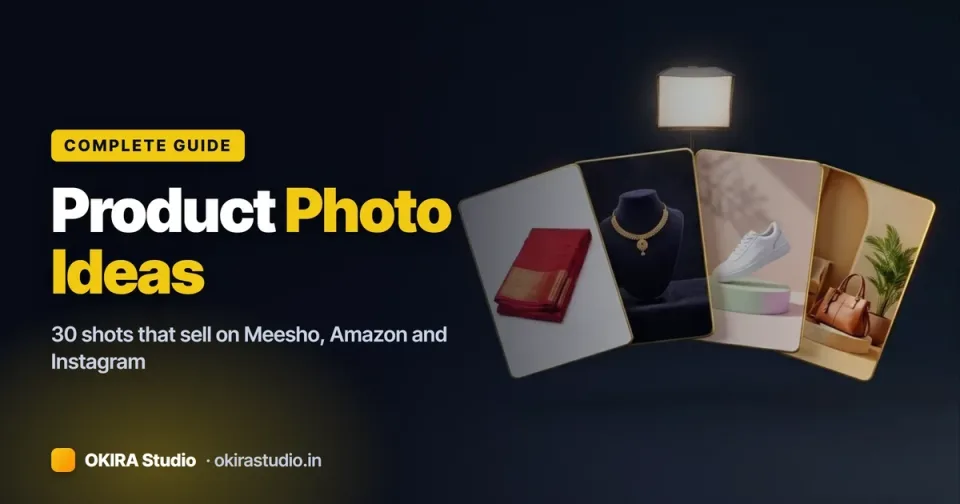
The best product photography props are simple things that show size, use or mood without stealing attention: a fabric, a riser, a tray, a few flowers or a diya. Use them in your extra listing images and social posts. Keep the main marketplace image clean, because Amazon does not allow props that do not come with the product.
This guide is for Indian sellers on Meesho, Amazon, Flipkart, Myntra, Instagram and WhatsApp who want better photos without a studio bill. With Diwali on 8 November 2026, you get prop ideas by product, a rule check for each marketplace, a rough rupee kit, a worked example and a clear view of when AI scenes replace physical props.
Key takeaways
- Props belong in photos 2 to 7 and on Instagram, not in the main marketplace image.
- One hero prop plus one small supporting prop is enough. More than that and the product gets lost.
- Pick props by product: fabric and a riser for sarees, velvet and a tray for jewellery, a stone or leaf for footwear.
- A useful starter kit from a local market costs a few hundred to a couple of thousand rupees.
- AI can place your product in a prop scene from one plain photo, which saves buying and storing props.
What are product photography props and why do they matter?
Good product photography props ideas are simple. Props are any objects placed near a product in a photo that are not the product itself. They do three jobs: show scale (a hand, a coin, a book), show use (a cup beside a tea tin) and set a mood (marigold flowers for a festive kurti).
A plain photo tells the buyer what the item is. A styled photo tells the buyer who it is for. On Instagram and WhatsApp, where nobody is comparing 40 near-identical listings, that second job often decides the sale.
The test for every prop is simple: if the buyer looks at the prop first, remove it. Props support the product. They never compete with it.
Product photography props rules on Amazon, Flipkart and Meesho
Before you style anything, know where props are allowed. The short version is that the first image is for the marketplace and the rest are for you.
| Platform | Main image | Other images |
|---|---|---|
| Amazon | Pure white background (RGB 255,255,255), product fills about 85% of the frame. Props that do not come with the product are not allowed. See the Amazon seller forum post on main images. | Lifestyle shots and styled scenes are fine and recommended. |
| Flipkart | Keep it clean on white or light grey, with no extra objects. | Styled and detail shots are fine. Check your seller panel for the current size rules. |
| Meesho | Meesho does not publish its image rules openly. They sit inside the Supplier Panel, so read them there. A clean, logo-free product shot is the safe choice. | Extra angles and detail shots help. Props are fine if the buyer still sees exactly what they will receive. |
| Instagram / WhatsApp | No rules. Use your best styled image. | Props, scenes and festive sets work well. |
One more point matters a lot on Meesho: the buyer must get what the photo shows. If a necklace photo includes a velvet bust and a gift box that you do not ship, say so in the listing or leave them out. Returns from a mismatched photo cost more than any prop saves.
Best props for product photography: the core set
You do not need fifty objects. These six cover most products, and each one is easy to find in an Indian local market or online.
1. Risers and blocks
A riser lifts the product off the flat surface so it has a shape and a shadow. Wooden blocks, a steel stand upside down, a stack of thick books or a cake stand all work. Risers are the first prop to buy.
2. Fabric and textiles
A plain cotton, linen or silk cloth gives colour and softness. Use a muted shade that sits behind the product. For bright products, grey or beige fabric is safest.
3. Trays and plates
A brass thali, a wooden tray or a small steel plate groups small items and feels Indian without trying hard. It works well for jewellery, candles and food gifts.
4. Natural accents
Marigold petals, a few dried flowers, a leaf, a small stone or a piece of wood. Keep them small and use only one or two.
5. Mirrors and reflective sheets
A small mirror or a piece of acrylic gives a soft reflection under shiny products like watches or perfume. A white sheet of paper on the other side bounces light back.
6. Context objects
A cup beside a tea tin, a book beside a bookmark, a diya beside a gift box. These tell the story of use. Choose one only.
Product photography props for jewellery
Jewellery is the hardest category because it is small, shiny and picks up every reflection. The wrong prop makes a gold necklace look cheap. For product photography props for jewellery, keep the list short:
- Velvet or suede pads in black, maroon or navy. They make gold and stones stand out and stop glare.
- Busts and ring cones to show how the piece sits when worn.
- A small tray or thali for sets like jhumkas with a maang tikka.
- A single flower or a pearl string for a premium look. Never a pile.
- Tweezers and a little museum wax to hold earrings and rings at the right angle. The buyer never sees them.
For a shine-free look, a simple product photography box (a small light tent) helps because it diffuses light from all sides. A basic folding box with built-in LED strips is easy to find online, and it also works for rings, watches and small cosmetics.
Product photography ideas clothes: sarees, kurtis and menswear
For product photography ideas clothes sellers can try without a model, think flat lay, hanging and folded.
- Saree: a pleated fold with the pallu draped over a wooden stool or a chair, a brass lamp or a jasmine string nearby. Show the border and the pallu close up in separate shots.
- Kurti: hang it on a plain hanger against a wall, or lay it flat on a wooden floor with a dupatta, a pair of jutti and a small potli bag.
- Menswear: a shirt flat lay with a watch, a belt and a wallet is a classic, but make sure the buyer knows those are not included.
- Kidswear: soft toys, wooden blocks and pastel fabric. Keep it light and clean.
Clothes are where props and a model matter together. If you cannot hire a model, an AI model shot can come later, and you can read how that works in our catalogue photography guides.
Product photography ideas for ecommerce listings
For marketplace listings, a good product photography ideas for ecommerce plan gives you seven images. Props appear in the later ones.
- Image 1: clean product on white. No props.
- Image 2: a second angle or the back.
- Image 3: a close-up of the fabric, stone or stitching.
- Image 4: the product with one scale prop, such as a hand or a coin.
- Image 5: a lifestyle scene with one hero prop.
- Image 6: what is in the box.
- Image 7: size chart or key features on a plain card.
This order helps because a buyer scrolling on a phone gets proof first and mood second.
Product photography ideas at home with things you already own
You can start today with what is in your house. These product photography ideas at home cost almost nothing:
- A steel stool or a kitchen shelf as a riser.
- A bedsheet or a dupatta as the backdrop, pressed flat.
- A wooden chopping board or a tray as a surface.
- A window with soft daylight instead of lamps. Shoot between 10 am and 2 pm, away from direct sun.
- A sheet of white chart paper as a reflector.
If your home is cluttered, a simple product photography backdrop made of a plain wall or a large piece of paper keeps the focus on the item. Our guide on the best background for product photography covers colours in detail.
Product photography ideas for beginners: a simple shot list
If you are new, use this order for every product. It stops you from forgetting an angle after the props are put away.
- Clean the product and iron or steam any cloth.
- Set the backdrop and place the riser.
- Shoot the clean white main image first, before any prop.
- Add one prop and shoot the front, side and detail.
- Swap in a second prop only if the first scene looks empty.
- Check each photo on your phone at small size. If the prop wins, take it out.
These product photography ideas for beginners work because they build on each other. The clean image is always done first and is never ruined by props.
Product photography ideas for Instagram and Diwali 2026
Instagram buyers want mood. Festive sets work well for the next two weeks, and a few product photography ideas for Instagram fit almost any product:
- Diya and marigold: a warm gold scene for jewellery, ethnic wear and gift boxes.
- Rangoli corner: a small rangoli on the floor with the product on a stool beside it.
- Gift stack: the product beside a wrapped box and a sweet box for gifting posts.
- Fairy lights, soft focus: lights blurred in the background add warmth with no extra objects.
- Brass and silk: a brass thali with a silk cloth gives a rich, traditional feel.
Keep the colour story to two colours. A red and gold scene looks rich. A red, green, blue and gold scene looks messy.
Product photography props India: where to buy and what it costs
Finding product photography props India sellers can trust is easier than most think. The prices below are rough ranges based on typical local market and online rates, so check your own city before buying.
| Prop | Where to find it | Rough cost | Good for |
|---|---|---|---|
| Wooden blocks or risers | Local carpenter, online craft shops | Under ₹500 | All products |
| Cotton or linen cloth (1 to 2 m) | Fabric market | Under ₹300 | Backdrop, texture |
| Velvet pad or bust | Jewellery packaging shops | ₹100 to ₹500 | Jewellery |
| Brass thali or tray | Pooja shop, kitchen store | ₹200 to ₹800 | Festive, gifts |
| Fresh marigolds, leaves | Flower market | Under ₹100 | Mood |
| Small light tent | Online marketplaces | ₹500 to ₹2,000 | Small items |
A starter kit from the table costs from a few hundred rupees to around two thousand rupees. If you shoot a lot, store props in one box so you do not rebuy them. Compare that with the studio rates in our OKIRA pricing and cost guide to see which route suits your volume.
Worked example: a silk saree from plain photo to catalogue set
Take one maroon silk saree. Here is how props change the result.
- Start plain. Hang the saree on a clean wall in daylight. Shoot the full length. This is image 1, with no props.
- Add detail. Shoot the border and the pallu close up. Still no props.
- Add one hero prop. Fold the saree in a stack on a wooden stool and place one brass diya beside it. This is the Diwali image.
- Add one scale prop. A hand holding the pallu shows the fabric weight and drape.
- Keep the clean image safe. Upload the plain one as the marketplace main image and the styled one as images 3 and 4.
The same saree, shot four ways, gives a full catalogue and an Instagram post from a single hour of work.
Product photography examples: props that work and props that hurt
Look at product photography examples from brands you admire and the pattern is the same: one idea per photo.
| Works | Hurts |
|---|---|
| One brass diya beside a saree stack | Five festive items and a patterned cloth |
| Velvet pad under a gold necklace | A shiny plate that reflects the flash |
| Plain wood riser under sneakers | A busy floor that competes with the shoe colour |
| One leaf near a herbal oil bottle | A prop that looks like part of the product |
Common prop mistakes and how to fix them
- Too many props. Remove until the product is the first thing you see.
- Props in the main marketplace image. Move them to image 3 onward.
- Props that look included. Add a line in the listing or crop them out.
- Clashing colours. Match the prop to the product colour family, or use neutral beige and grey.
- Hard shadows. Use soft window light and a white reflector.
- Dust and creases. Steam cloth props and wipe glass and brass before each shoot.
Props or AI scenes: which should you use?
Physical props give you full control and look real, but they cost money, take space and eat shoot time. AI scenes let you place the same product on a marble table, a festive set or a wooden shelf from one plain photo.
OKIRA AI catalogue generator does this for fashion and lifestyle sellers: you upload a plain product photo, and it generates AI models, backdrops and studio lighting as catalogue-ready 4K images. That makes it useful when you have 200 SKUs and cannot style each one by hand.
| Need | Physical props | AI scenes |
|---|---|---|
| Few products, high detail | Best | Good as a second set |
| Many products, same look | Slow | Best |
| Festive variety on a budget | Costs add up | Fast to change |
| Real texture and scale | Best | Check the result carefully |
My view: shoot the clean main image yourself, and use AI scenes for the festive and lifestyle images. Always check that colour, print and size still match the real product.
Conclusion and next steps
The best product photography props are the ones the buyer barely notices. Start with a clean main image, add one hero prop for images 3 to 5, and keep the colour story to two shades. This weekend, buy a riser, one cloth and one tray, shoot three products, and compare the clean and styled versions on your phone.
If you want to skip the buying and styling, you can book a demo of OKIRA and see your own product in a prop scene in minutes.


Comments
No comments yet — start the conversation.